Ultralight MDF vs Standard MDF for Miami Cabinet Shops
Ultralight MDF vs Standard MDF for Miami Cabinet Shops
Buyers comparing ultralight MDF Miami options should not treat “lighter” as a complete specification. The right choice depends on the finished component, handling plan, machining and finish process, hardware location, indoor exposure, documentation, and current data for the exact product, mill, and thickness.
This guide does not declare one category universally better. It shows what a production manager should verify before releasing a cabinet, millwork, fixture, furniture, or RTA run.
The short answer: choose by the finished component
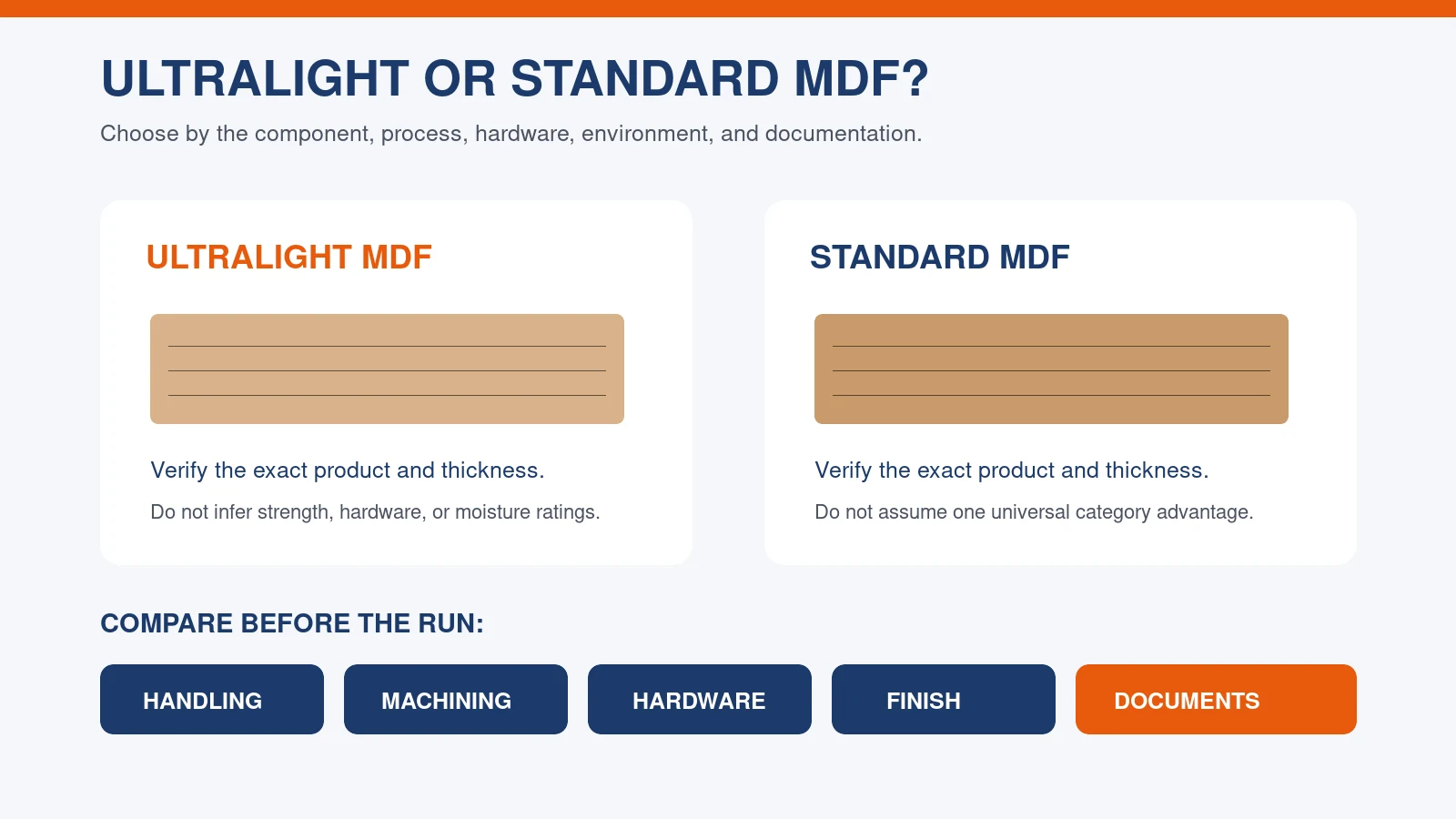
| Decision factor | Ultralight MDF | Standard MDF | Verify before purchase |
|---|---|---|---|
| Density and handling | Lower-density product category; exact value is product-specific | Values vary by product, mill, and thickness | Current technical sheet for the exact panel |
| Machining | Some named lines are positioned for moulding, millwork, or CNC-related uses | Some named lines are positioned for profiling and general industrial use | Actual tooling, profile, and trial cut |
| Finish or lamination | Suitability varies by named product | Raw, TFL, veneer, and finish suitability vary by product | Panel, adhesive, and finish-system instructions |
| Fasteners and hardware | Do not infer equality from the MDF label | Do not assume a universal advantage | Face and edge data plus an assembly mock-up |
| Moisture and location | Ultralight does not mean moisture resistant | Standard does not automatically mean MR | Indoor environment and exact exposure rating |
| Emissions paperwork | Verify the actual panel or bundle label | Verify the actual panel or bundle label | Producer, lot, TPC number, and TSCA statement |
These are category-level screening questions. The final purchase decision must use the exact product and current documentation. Browse the broader range of MDF board options in Miami, then call to confirm the panel for the job.
Density and handling: what ultralight can tell you
Density is mass per unit volume. The word “ultralight” signals a lower-density product family, but it does not create one universal density, sheet weight, or percentage saving. Manufacturer data can vary by product, thickness, and mill. Because the retrieved technical sheets did not show unambiguous current revision dates, this article intentionally avoids numerical density ranges.
Translate density into shop questions. Who unloads, stages, flips, machines, and installs the component? How often is it handled? Will finished-product mass affect packaging, installation, hinges, slides, or user operation? Does the panel size require a different lift plan? Those questions make “lighter” operational instead of promotional.
Lower density alone does not prove equal bending strength, stiffness, internal bond, or fastener withdrawal. A specification that depends on those properties must identify the exact product and review its current data.
Machining and finishing require a real shop trial
ARAUCO’s active Trupan Ultralight product page positions that named line for furniture, moulding, doors, fixtures, and CNC spoilboards. Its Trupan Standard product page positions the standard line for cabinets, furniture, profiling, and finishing. Those are manufacturer application descriptions, not proof that either category will produce a better edge in every shop.
Run the actual toolpath before production. Use the intended cutter, profile depth, feed and speed, drilling pattern, primer, topcoat, veneer, or laminate system. Inspect the face, routed edge, corner, and fastener locations. A small mock-up is more useful than a blanket claim about tool life, tear-out, sanding, or finish quality.
Laminated assemblies also need compatible panel, adhesive, restraint, and conditioning instructions. The Composite Panel Association’s dimensional-stability bulletin explains why unequal restraining layers can contribute to imbalance. Follow the current instructions for the actual panel and finish system rather than copying a universal conditioning time.
Fasteners, hinges, and slides need exact panel data
Face fastening and edge fastening are different conditions. Record where each screw lands, the screw type and penetration, the pilot-hole method, the hinge or slide pattern, expected cycles, and service load. Do not infer a safe door size, hinge count, shelf span, or hardware life from the words “ultralight” or “standard.”
The Composite Panel Association identifies ANSI A208.2-2022 as its current MDF standard for interior applications, and its 2022 announcement states that the edition superseded the 2016 standard. The standard contains grade-specific property requirements, but an unlabeled panel should not be assigned a grade by assumption.
For heavy, repeated-use, or edge-fastened hardware, compare the current fastening data for the exact product and build a representative mock-up. If the project requires engineering or a tested assembly, route it to the appropriate design professional rather than turning a buying guide into a structural table.
Indoor use and moisture are separate decisions
“Ultralight” is a density category, not a moisture-resistance rating. “Standard” also does not automatically mean moisture resistant. The active ARAUCO product pages position the named standard and ultralight lines for interior applications, but detailed exposure instructions must come from the current sheet for the exact product.
Tell the supplier whether the component may encounter splash, condensation, high humidity, recurring wetting, or exterior exposure. State whether the project requires an MR grade or another explicitly rated substrate. Do not describe ordinary MDF as waterproof, exterior rated, structural, or suitable for a wet location without verified product documentation.
For the broader substrate decision, read MDF versus plywood for Miami cabinet work. Keep that question separate from the comparison between two MDF product families.
Verify TSCA Title VI paperwork on the actual order
EPA regulates MDF under TSCA Title VI and explains the certification and labeling framework in its regulated-stakeholder FAQ. For a current order, check the panel or bundle label for the producer, lot, assigned third-party certifier number, and TSCA Title VI compliance statement. Align that information with the shipment documentation.
Do not say “EPA certified.” EPA recognizes third-party certifiers; it does not issue a product certificate for each panel. If a project separately asks for CARB documentation, review the current CARB certified-mills resource and the actual lot records. CARB states that listed mills may also make products that do not comply, so a mill-list entry does not prove every product or lot.
Certification requests should name the exact evidence required. Do not infer CARB, FSC, SFI, ECC, GREENGUARD, NAF, ULEF, fire, or other status from a generic product page or an inventory description.
Ultralight MDF Miami ordering checklist
- MDF type: ultralight or standard.
- Manufacturer, product line, or grade: include only when specified.
- Thickness and sheet size: state the required dimensions.
- Quantity: number of sheets.
- Component: door, panel, moulding, fixture, furniture part, RTA part, or another interior component.
- Machining: sawing, routing, profiling, drilling, or another operation.
- Finish: paint system, veneer, TFL, low-pressure laminate, or another finish.
- Hardware: face or edge attachment and any required test value.
- Environment: indoor conditions and any moisture-resistance requirement.
- Documentation: TSCA statement or other project submittal requirement.
- Delivery ZIP: shop or jobsite ZIP.
Cabinet and millwork buyers can also review International Plywood’s cabinet shop lumber supplier in Miami page. Current inventory, pricing, dimensions, and delivery timing must still be confirmed for the exact quote.
Frequently asked questions
Is ultralight MDF as strong as standard MDF?
There is no universal equivalence. Compare the relevant mechanical and fastening properties for the exact product, mill, and thickness. Test critical assemblies and use project engineering where required.
Does ultralight MDF machine differently?
Some named lightweight lines are marketed for machining applications, and some standard lines are marketed for deep profiling. Results depend on the exact panel, tooling, profile, and process. Run the real operation before releasing production.
Can ultralight MDF hold cabinet hardware?
Do not answer by category alone. Identify face versus edge fastening, review the current product data and instructions, then prototype heavily loaded or high-cycle hardware.
Is ultralight MDF moisture resistant?
Not because it is ultralight. Density and moisture classification are separate. Verify an explicitly rated product when the exposure requires moisture resistance.
Can standard or ultralight MDF be used outdoors?
Do not infer outdoor suitability from the MDF category. The named ARAUCO pages position these lines for interior applications. Verify current documentation and choose an explicitly rated substrate for exterior exposure.
What should I send for an MDF quote?
Send MDF type, thickness, sheet size, quantity, component, machining or finish requirement, delivery ZIP, and any hardware, moisture, grade, or documentation requirement.
Get the MDF specification right before the run starts
Call International Plywood at (305) 884-0860 or request an MDF quote. Our team will confirm the exact product, current inventory, price, specifications, and delivery timing. Hablamos Español. Llámenos al 305.884.0860.