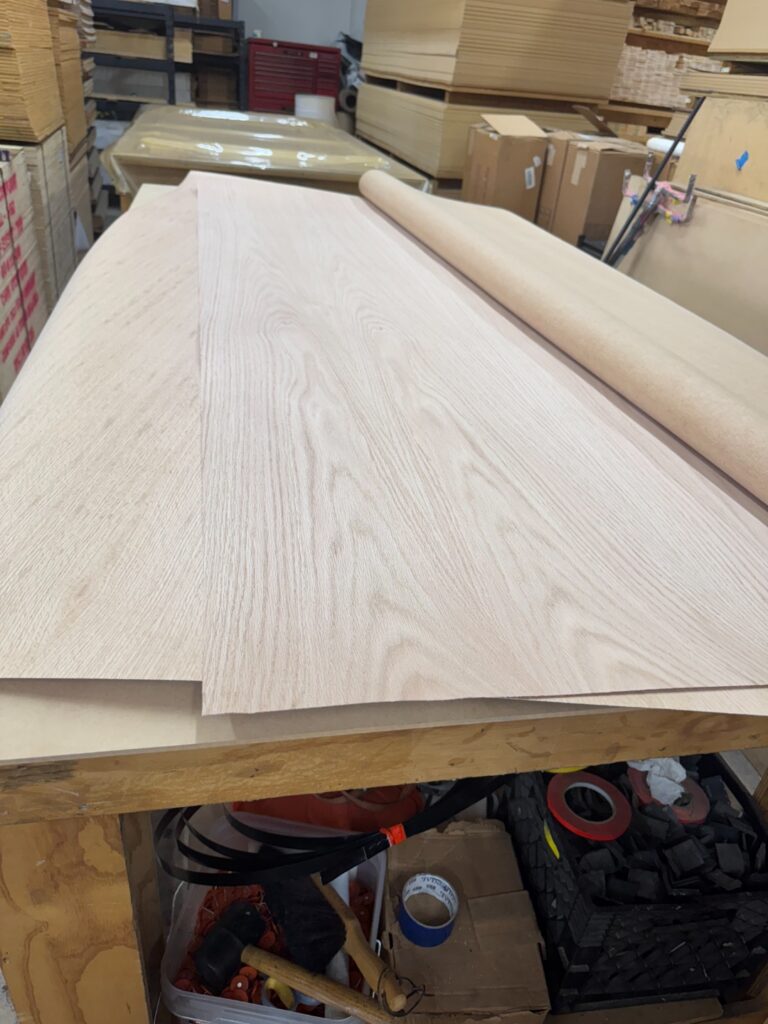
4×8 vs 5×10 Baltic Birch for Miami Cabinet Shops
Table of Contents
- Start With the Finished Parts, Not the Sheet Price
- 4×8 vs 5×10 Baltic Birch at a Glance
- 5×10 Baltic Birch Plywood Miami: Shop-Fit Questions
- Confirm Grade, Core, Bond, and Actual Thickness
- Plan Receiving and Storage Before the Truck Arrives
- Send a Quote Request the Sales Team Can Use
- Frequently Asked Questions
- Confirm the Panel Before Releasing the Job
If your search is “5×10 Baltic birch plywood Miami,” start with the cut list and machine envelope, not the sheet price. A larger panel can solve the right layout problem, but it can also create new handling, storage, and machining problems when the shop is not set up for it.
This guide helps cabinet shops, millwork companies, fixture builders, furniture manufacturers, and CNC operators compare 4×8 and 5×10 formats before requesting a quote. The best choice depends on the finished parts, grain direction, trim, kerf, grade, machine capacity, receiving plan, and the specification for the exact panel.
Need a Baltic birch quote? Call (305) 884-0860 or request a plywood quote with the thickness, face/back grade, sheet size, quantity, cut list or largest part dimensions, CNC requirements, and delivery ZIP. Hablamos Español.
Start With the Finished Parts, Not the Sheet Price
Choose 4×8 or 5×10 Baltic birch by comparing the finished-part cut list against each sheet size. Check grain direction, trim allowance, kerf, machine capacity, handling, storage, and required grade. A 5×10 panel can help some layouts, but it does not guarantee lower waste on every job.
The cut list should show every finished width and length, the required quantity, whether grain direction matters, and which edges need banding or finish. Add the saw kerf or router-bit diameter, perimeter trim, tab or onion-skin allowance, and any defect areas the operator expects to avoid. Those inputs matter more than a general statement that a larger sheet is “more efficient.”
Run the same job through both sheet sizes when yield matters. A 5×10 format may fit long wardrobe parts, wide fixture components, or fewer seams on a large assembly. A 4×8 format may fit the existing machine, rack, cart, and production flow with less disruption. Only the actual nests can show which format uses material better for that job.
4×8 vs 5×10 Baltic Birch at a Glance
| Decision factor | 4×8 panel | 5×10 panel | Verify before ordering |
|---|---|---|---|
| Cut-list fit | Familiar baseline for standard layouts | May fit longer or wider parts and reduce seams on some jobs | Compare both nests using the actual parts |
| CNC compatibility | Matches a standard 4×8 work envelope | Requires a machine and loading setup that accepts the full panel | Usable bed dimensions, hold-down area, and loading clearance |
| Handling | Smaller footprint | Larger footprint and more turning clearance | Crew, lift equipment, aisle, door, and rack access |
| Storage | Fits common 4×8 supports and racks | Needs full, level support for a 60×120 panel | Rack dimensions and support points |
| Grade and faces | Varies by shipment and specification | Varies by shipment and specification | Face/back grade and permitted repairs |
| Core and bond | Do not assume from the trade name alone | Do not assume from the trade name alone | Actual mill or supplier data sheet |
| Quote accuracy | Needs thickness, grade, quantity, and delivery details | Needs the same details plus oversize-handling confirmation | Cut list or largest part dimensions |
Use this table as a screening tool, not as a product specification. Review International Plywood’s Baltic birch grades and available formats and call to confirm the exact material for the order.
Need wholesale pricing on this material?
Send thickness, quantity, jobsite ZIP, and your required delivery date. Hablamos Español.
Call (305) 884-08605×10 Baltic Birch Plywood Miami: Shop-Fit Questions
A machine described as 4×8 or 5×10 still needs a usable-work-area check. Confirm the real cutting envelope after allowing for stops, clamps, vacuum zones, spoilboard condition, tool clearance, and any inaccessible edge area. The marketed bed size does not prove that a full panel can be secured and machined through the intended toolpath.
Next, trace the panel’s route from the truck or pickup point to the rack and machine. Check the receiving opening, aisle width, turn radius, forklift or cart capacity, lifting plan, and clear space around the table. Do not prescribe a crew size or handling method from the sheet dimensions alone. The exact panel weight, workplace conditions, and equipment must be evaluated by the shop.
Finally, ask whether the extra width and length will appear in the finished parts. If the job consists mainly of smaller components, a larger sheet may not improve the nest enough to justify a different handling flow. If the project includes long sides, wide doors, full-height carcass parts, or large fixture panels, the larger format may deserve a direct nesting comparison.
Confirm Grade, Core, Bond, and Actual Thickness
B/BB and similar notation identifies the face and back grade. It does not, by itself, guarantee every inner ply, glue line, thickness tolerance, country of origin, emissions document, or finish. Common face/back combinations include B/BB, BB/BB, BB/CP, and CP/CP, with different visible repairs and permitted characteristics. Confirm the exact grading specification for the panel being quoted.
A current supplier technical sheet lists those grade combinations plus 4×8, 5×5, and 5×10 formats with several metric thicknesses. The same sheet states that specifications may be substituted based on availability. That is why the quote and receiving check should identify the actual panel, not rely only on the words “Baltic birch.”
Ask for the supplier or mill data that matters to the job: nominal and actual thickness, face/back grade, allowed repairs, core construction, bond type, finish, emissions paperwork, and country of origin when required. All-birch multi-ply construction may provide a more consistent edge, subject to the actual grade and supplier specification. Do not treat “void-free” as a universal guarantee.
Cabinet-grade Baltic birch is not automatically an exterior, marine, structural, or code-rated panel. If the component may see water, exterior exposure, or a regulated assembly, specify a product with the required documentation instead of extending an interior cabinet claim. For broader alternatives, compare cabinet-grade birch core and face options.
Plan Receiving and Storage Before the Truck Arrives
The Canadian Wood Council plywood handling guide recommends storing panels flat and level, protecting finish faces, edges, and corners, and avoiding water or excessive humidity. It also recommends storing interior-finish plywood under conditions close to those expected in service.
Those controls matter in South Florida. Keep interior panels dry, elevated from the slab, supported across the full format, and away from rain or abrupt moisture changes. A rack built only for 4×8 material may not fully support a 60×120 sheet. Confirm the rack, bunks, or platform before the order arrives rather than improvising with an oversize stack.
Protect visible faces from abrasion and contamination. Carrying and staging plans should also protect corners and edges, especially when an exposed layered edge is part of the design. Confirm the current stock, exact specifications, pickup plan, and delivery schedule with the sales team. This article does not promise availability or a delivery time.
Send a Quote Request the Sales Team Can Use
- Finished parts: Send the cut list or the largest finished dimensions.
- Thickness: State the nominal requirement and any actual-thickness tolerance.
- Sheet format: Request 4×8 or 5×10, or ask for both to compare nests.
- Grade: Identify the face/back requirement and acceptable patches or repairs.
- Documentation: List any core, bond, emissions, finish, or origin evidence the job requires.
- Quantity: Provide the sheet count or enough information to estimate it.
- Equipment: Note the CNC bed, saw, rack, or receiving limitation when relevant.
- Delivery: Include the shop or jobsite ZIP and any receiving constraint.
- Timing: State the required date so availability and scheduling can be confirmed.
For related shop materials, visit the materials for Miami cabinet shops page. If the face grade is the main question, read how Baltic birch face and back grades work.
Frequently Asked Questions
Is a 5×10 Baltic birch sheet always more efficient than 4×8?
No. Efficiency depends on the cut list, grain direction, trim, kerf, defects, and machine constraints. Compare both nests before deciding.
Can a 4×8 CNC router cut a full 5×10 sheet?
Do not assume it can. Confirm the machine’s usable work envelope, hold-down system, loading clearance, and manufacturer instructions.
What does B/BB mean on Baltic birch plywood?
It is a face/back grade designation. Confirm the exact allowed repairs and defects against the supplier or mill grading specification.
Is Baltic birch plywood void-free?
Do not treat “void-free” as a universal guarantee. Core quality and permitted defects vary by grade and supplier specification. Review the data sheet for the actual panel.
How should a 5×10 plywood panel be stored?
Store it flat, level, fully supported, dry, and protected from face, edge, and corner damage.
What information should a Miami cabinet shop send for a quote?
Send thickness, grade, sheet size, quantity, cut list or largest part dimensions, documentation needs, delivery ZIP, receiving limits, and required date.
Confirm the Panel Before Releasing the Job
Call International Plywood at (305) 884-0860 or request a plywood quote with the thickness, grade, sheet size, quantity, cut list or CNC nesting requirements, and delivery ZIP. Our team will confirm current stock, specifications, pricing, and delivery scheduling before the order is finalized. Hablamos Español. Llámenos al 305.884.0860.
Get a Quote From Our Team
Wholesale pricing. Real inventory. Delivered to your site. Trade professionals only — Hablamos Español.