Buying Plywood Wholesale in Miami: Units, Pallets and Bulk Orders
Buying Plywood Wholesale in Miami: Units, Pallets and Bulk Orders
Table of Contents
Buying plywood wholesale in Miami means buying by the unit rather than the sheet, and it changes three things: how the panels are priced, how they are handled, and what you need to specify before anyone can quote you. This guide explains what a unit is, what to confirm at each order size, why buying down a grade usually costs more in the end, and what to send us so a bulk quote comes back accurate the first time.
What “wholesale” and “bulk” mean in panel supply
In panel distribution, wholesale describes who you are, and bulk describes how much you buy. They usually travel together but they are not the same thing.
- Wholesale / trade means you are buying to install, fabricate, or resell — a general contractor, cabinet shop, millwork or production shop, marine builder, or crating and export operation. We sell to trade professionals.
- Bulk refers to quantity tiers above a loose sheet count: a partial unit, a full unit, several units, or a full truckload or container.
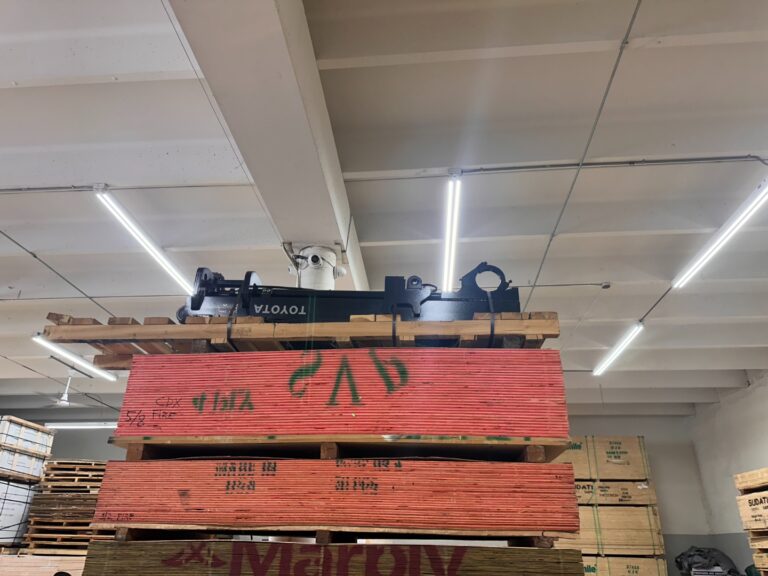
A unit (also called a lift or a bundle) is a mill-banded stack of identical panels on a base, built to a target stack height rather than a fixed sheet count. Because the height target is roughly constant, the number of sheets in a unit falls as panel thickness rises — a unit of 1/4″ holds far more sheets than a unit of 3/4″. Mills and product lines differ, so confirm the actual sheet count on the packing list or with our counter before you build a takeoff around it.
Why the unit matters to your estimate
Panels bought by the unit are priced on a different basis than panels pulled loose off a stack, because loose picking is labor. If your takeoff lands just over a unit boundary, it is often worth asking whether rounding up to the full unit changes your per-sheet basis. That is a question for the counter, not an assumption — call (305) 884-0860 and ask.
What to confirm at each order size
The larger the order, the more of the transaction is logistics rather than product. Use this as a pre-order checklist rather than a price list.
| Order size | Typical buyer | What to confirm before you commit |
|---|---|---|
| Loose sheets | Repairs, punch list, small shop runs | Current stock on the exact thickness and grade; whether you are cutting on site or need it cut |
| Partial unit | Single-job framing, cabinet run | Whether a partial pull is available on that item; how it is banded for transport |
| Full unit | Production shops, multi-unit framing | Sheet count on the packing list; species and grade stamp; how you will offload it |
| Multiple units | Larger sites, recurring shop demand | Whether the items ship together; staging space and storage conditions on your end |
| Truckload / container | Resale, export crating, scheduled production | Mix across items; documentation you need; offload equipment and receiving hours at your end |
Notice what is missing from that table: prices and lead times. Both move with the market and with what is on the floor that week, which is why we quote them rather than publish them. Call for current stock.
Handling is the part buyers underestimate
A full unit of panels is heavy, awkward, and cannot be moved by hand. Before a bulk order leaves our yard, settle how it comes off the truck at your end — whether you have a forklift with adequate fork length and capacity for a full lift, a loading dock, or need us to arrange offload. Sorting this out at quote time avoids a truck sitting at your gate.
Storage matters just as much. Panels stored flat, off the ground, and out of direct weather stay flat. Panels leaned against a wall or left in the sun on a Miami afternoon do not.
Pricing a bulk order?
Send us the item and grade, thickness, sheet or unit quantity, your delivery ZIP, and your offload method. That is everything we need to quote accurately. Call (305) 884-0860 or request a quote. Hablamos Español.
Need wholesale pricing on this material?
Send thickness, quantity, jobsite ZIP, and your required delivery date. Hablamos Español.
Why “cheap plywood” is the wrong question
The lowest sheet price and the lowest project cost are frequently different panels. Grade, species, glue line, and thickness all move price, and each one is doing a job.
- Face grade drives how much finish labor follows. A panel that needs filling and extra sanding can cost more in shop hours than the grade above it costs in material.
- Void content and core quality determine whether edges machine cleanly and whether fasteners hold. This is where the cheapest import panels usually give way.
- Exposure rating reflects how the panel tolerates moisture during construction. Buying below what the application needs is the most expensive mistake on this list.
- Treated versus untreated is not a grade question. Unless a panel is specified and stamped as preservative treated, it carries no rot or termite protection.
The useful version of “what is your cheapest option” is “what is the least expensive panel that still does this job”. Tell us the application — sheathing, cabinet boxes, concrete forming, crating, temporary protection — and we can answer that. It is a better conversation than a bare price request, and it is usually a cheaper outcome.
South Florida considerations
Humidity and storage
Panels arrive at an equilibrium moisture content set by where they were made and stored. In South Florida they will move toward local humidity. For cabinet and millwork stock especially, let panels acclimate in the space where they will be worked, stacked flat and separated from the slab, before you cut and machine them. Cutting straight off the truck is a common source of movement complaints.
High Velocity Hurricane Zone work
Miami-Dade and Broward sit in the High Velocity Hurricane Zone (HVHZ), which carries its own approval and documentation requirements under the Florida Building Code. Product approval is specific to a product, an assembly, and an application — it is not a property of a species or a grade. If your scope is permitted in the HVHZ, verify that the specific panel you intend to buy carries current product approval documentation for your assembly, and confirm with your engineer of record or building official for your permit. Tell us the approval requirement at quote time so we are pricing something that can actually be installed.
Marine, crating and export
Coastal and marine work, and export crating, each bring requirements that sit outside ordinary construction panels — different glue lines and species for marine service, and phytosanitary documentation considerations for wood packaging leaving the country. Raise these at the start of the quote rather than after the units are banded.
Setting up as a trade buyer
If you are buying repeatedly, it is worth being set up as an account rather than quoting from scratch each time. Practically, that means we know your shop, your usual items, your delivery address and offload situation, and who is authorized to pick up. Recurring buyers get faster quotes because most of the questions above are already answered.
Come see the yard if it helps: 7340 NW 56th St, Doral, FL 33166, Monday through Friday, 7:30 AM to 4:00 PM. Bring the spec or the drawing.
A short decision path
- Name the application first. Sheathing, cabinet box, forming, crating, marine, or temporary. This determines species, grade, and exposure before price enters the conversation.
- Fix the thickness to the requirement, not to habit — and for structural work, to the span rating your inspector reads.
- Decide your order tier and ask whether rounding to a full unit changes your basis.
- Settle offload and storage before the truck is scheduled.
- If it is permitted HVHZ work, confirm product approval documentation for your assembly before you commit.
- Send the five quote inputs — item and grade, thickness, quantity, delivery ZIP, offload method.
The takeaway
Bulk plywood buying rewards specificity. The buyers who get accurate quotes fastest are the ones who lead with the application and the logistics rather than the price, because those are the variables that actually determine what the panel costs them installed. Prices and availability move week to week — call for current stock and we will quote what is on the floor.
Keep Reading
- Bulk SYP Plywood: Grades, Span Ratings and Ordering by the Unit
- CDX Plywood Wholesale Pricing
- Browse All Panel Products
- Shop CDX Plywood in Miami or Hardwood Plywood
Ready for a bulk quote? Send item and grade, thickness, quantity, delivery ZIP and offload method to (305) 884-0860 — call for current stock. 7340 NW 56th St, Doral, FL 33166, Mon–Fri 7:30 AM–4:00 PM. Hablamos Español.
Get a Quote From Our Team
Wholesale pricing. Real inventory. Delivered to your site. Trade professionals only — Hablamos Español.