Miami Art Week 2026 Build Guide: Plywood, MDF and Lumber for Booths, Pop-Ups and Installations
Table of Contents
Miami Art Week runs November 30 through December 6, 2026, and Art Basel Miami Beach opens its private days at the Miami Beach Convention Center on December 2 — which means booth walls, pop-up rooms, plinths, platforms and installation framing for the week are being cut and assembled in November. This guide is for the fabricators, exhibit builders, production companies, event designers and galleries building for the week: which panels and lumber fit each part of a build, what the convention center expects on fire retardancy, and what to send us so a quote comes back right the first time.
The 2026 build calendar
Art Basel Miami Beach takes place December 4–6, 2026, with VIP Preview Days on December 2 and 3, at the Miami Beach Convention Center (Art Basel). The wider Miami Art Week runs November 30 through December 6 across Miami Beach, Wynwood, Downtown and other neighborhoods, with more than 20 satellite fairs and events (Miami Art Week).
Working backward from those dates, most shops follow a similar rhythm:
- Early to mid November: drawings final, material takeoffs done, panels and lumber ordered so the shop is not waiting on material.
- Mid to late November: fabrication, finishing and paint in the shop; crating or staging for load-in.
- Final days of November and early December: load-in and install at the convention center and satellite venues, with last-minute repair and change-order material.
The single most common problem we hear in December is not a design issue — it is a shop that ordered late and had to substitute a different panel than the one in the drawings. Order the main material early, and keep a small buffer of the panels you are most likely to damage or recut on site.
Which material fits which part of the build
Art and exhibit builds combine three kinds of work: structure the public never sees, surfaces the public sees up close, and finishes that have to photograph well under hard lighting. The panel choice should follow that split.
| Build element | Common material | Why builders choose it |
|---|---|---|
| Booth and gallery walls (framing) | Dimensional lumber, typically 2×4 and 2×3 studs | Fast to frame, easy to modify on site, familiar to every crew |
| Paint-grade wall skins | MDF or MDO plywood | Smooth, uniform faces that take paint without telegraphing grain |
| Plinths, pedestals and display cubes | MDF, or birch or Baltic birch plywood where edges show | Crisp edges and corners; Baltic birch gives a clean exposed edge |
| Platforms, risers and stage decks | Structural plywood such as CDX over framing | Strength at a reasonable cost; finished with a top layer or carpet |
| Exposed-wood installations and furniture | Hardwood plywood, Baltic birch, S4S hardwood lumber | Attractive face and edge that can be left natural or clear-coated |
| Crating and transport | Plywood and crating lumber | Protects artwork and booth components during transport and storage |
Exact thicknesses depend on span, framing spacing and load, so size them from your drawings or your engineer, not from a rule of thumb. If you are unsure between two panels, call us with the use and span and we will talk it through.
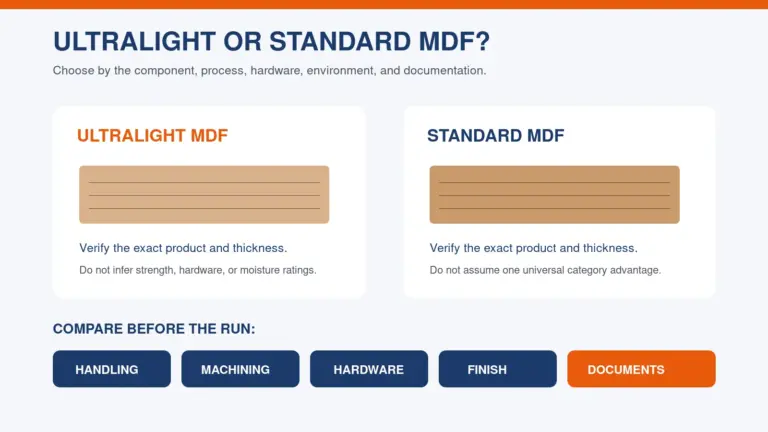
MDF versus plywood for paint-grade walls
MDF gives the smoothest paint surface and the most consistent flatness, which is why gallery-style walls often use it. It is heavier than plywood and does not like moisture or repeated screw removal. Plywood — especially MDO — holds fasteners better and handles knocks during load-in and load-out. Many builders skin with MDF where the public is close and use plywood where the wall takes abuse. Our MDF vs plywood guide covers the tradeoffs in more detail.
Need wholesale pricing on this material?
Send thickness, quantity, jobsite ZIP, and your required delivery date. Hablamos Español.
Call (305) 884-0860Fire retardancy: plan for it before you order
Convention center rules are strict about combustible materials. The Miami Beach Convention Center exhibitor guidelines state that all woodwork, stage scenery, furnishings, decorations and sets used in an exhibit or on a stage shall be coated or treated by approved methods to render them fire-retardant, and that documentation of fire retardants must be available for review on request (MBCC exhibitor guidelines). Multi-level booths at the venue also require certification by a Florida-licensed structural engineer and a Miami Beach building permit (MBCC exhibitor manual).
In practice, builders take one of two routes:
- Use fire-retardant-treated (FRT) plywood and lumber for the parts that need it, and keep the treatment paperwork with the build.
- Apply an approved fire-retardant coating to standard materials, following the coating manufacturer’s directions and keeping its documentation.
Always confirm the current requirements with your show organizer and the venue before you order — rules are set by the show, the venue and the fire marshal, and they can differ between the main fair and satellite venues. For fire-retardant panel options, see our fire-retardant plywood page and our guide to when fire-retardant plywood is required, then call for current stock.
Satellite fairs, pop-ups and private events
Much of the week happens outside the convention center: satellite fairs in tents and warehouses, brand activations, gallery pop-ups, hotel and rooftop events, and private dinners. These builds tend to be faster and more improvised, and they bring their own issues:
- Outdoor and tent builds face humidity, rain and sun. Use materials suited to exterior exposure where it matters, and seal raw edges.
- Tight venues limit how big a panel can travel through the door or elevator. Check access before you order full sheets you cannot get inside.
- Short timelines mean change orders. Know who you will call when a wall gets damaged at 6 PM the day before opening.
What to send for an accurate event-build quote
Event quotes go faster when we have the full picture in one message. Send:
- Material list: product, thickness and quantity for each item (panels and lumber)
- Any fire-retardant requirement, and whether you need treated material or plan to coat
- Finish expectations: paint-grade, stain-grade or hidden structure
- Delivery address or venue, your load-in window and how the material will be unloaded
- Your show or project name, so we can keep your orders together
We are a family-owned plywood and lumber wholesaler in Doral, serving trade customers across Miami-Dade, Broward and Palm Beach counties since 1983. Delivery available, and pickup at our Doral warehouse. Hablamos Español.
Frequently asked questions
When should we order materials for Miami Art Week?
Most builders place their main material orders in early to mid November so fabrication can run through the second half of the month. Late orders risk substitutions on specific panels.
Do you sell to galleries and event companies, not just contractors?
Yes. We sell to trade buyers, including exhibit builders, fabricators, production companies, event designers and galleries building their own booths.
Can you deliver to the Miami Beach Convention Center or a satellite venue?
Delivery is available across Miami-Dade, Broward and Palm Beach counties. Venue deliveries depend on the venue’s receiving rules and your load-in schedule, so call (305) 884-0860 with the address and window before you order.
Keep Reading
- Event Construction & Set Design Lumber in Miami
- Lumber & Plywood for Event Staging
- CDX vs OSB for Event Staging
- Shop MDF Board, Baltic Birch or Fire-Retardant Plywood
Building for Art Week? Send your material list, fire-retardant needs, venue and load-in window to (305) 884-0860 — call for current stock. 7340 NW 56th St, Doral, FL 33166, Mon–Fri 7:30 AM–4:00 PM. Hablamos Español.
Trade Newsletter
Get new arrivals and material guides by email
For contractors, cabinet shops, marine builders and millwork companies in South Florida. Occasional emails, unsubscribe anytime. Hablamos Español.
Get a Quote From Our Team
Wholesale pricing. Real inventory. Delivered to your site. Trade professionals only — Hablamos Español.