MDF vs Plywood for Cabinets: What Miami Cabinet Shops Need to Know
Table of Contents
- Why the choice is different in Miami
- MDF: what it does well and where it fails
- Plywood: what it does well and where it costs more
- MDF vs plywood: side-by-side
- Moisture-resistant MDF and sealing
- Which panel goes where
- The hybrid spec: plywood boxes, MDF doors
- Typical thickness by component
- Order checklist for a cabinet run
- Frequently asked questions
- Keep Reading
- Get new arrivals and material guides by email
Use plywood for cabinet boxes, drawer boxes and anything that carries hardware or load, and MDF (moisture-resistant MDF in kitchens and baths) for painted doors, routed profiles and flat panels. Plywood holds screws in its edges and tolerates humidity swings better; MDF machines and paints smoother. In Miami, many shops get the best result from a hybrid: plywood boxes with MDF doors, every MDF edge fully sealed. This guide covers where each panel performs, how Miami humidity changes the decision, typical thicknesses by component, and what to send us for an accurate quote.
Why the choice is different in Miami
Both panels have a legitimate place in cabinet work. What changes in South Florida is the moisture load. Miami’s relative humidity averages in the mid-70s percent across the year, and early-morning readings commonly run above 80% (CityRating, WeatherHack). Panels stored in an open garage, delivered to a job site before the A/C is running, or installed next to a dishwasher or shower see that moisture every day.
That does not rule MDF out. It means the substrate, the sealing and the location in the cabinet have to be chosen together.
MDF: what it does well and where it fails
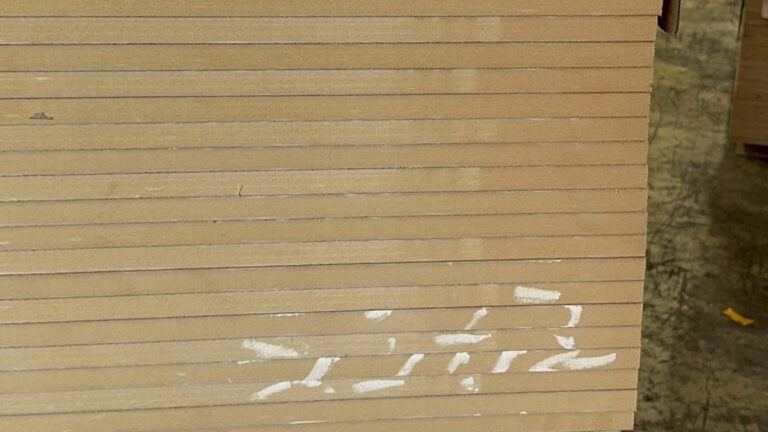
Medium-density fiberboard is made by reducing wood to fiber, blending it with resin and pressing it into a dense, uniform sheet. There is no grain and no core voids, so the face and edge are consistent across the whole panel.
- Flat and stable in a conditioned space — the reason it is the default for painted flat-panel and Shaker doors.
- Machines cleanly — routed profiles and CNC work come off without tear-out.
- Paints smooth — no grain telegraphing through the topcoat.
- Heavy — a 3/4″ 4×8 sheet typically weighs roughly 80–100 lb depending on density and brand, a two-person lift.
- Weak at the edge — screws driven into an MDF edge strip easily, a problem for hinges, slides and box joinery.
- Moisture sensitive — standard MDF absorbs water through unsealed edges and swells; the swelling does not go back down.
Need wholesale pricing on this material?
Send thickness, quantity, jobsite ZIP, and your required delivery date. Hablamos Español.
Call (305) 884-0860Plywood: what it does well and where it costs more
Cabinet-grade hardwood plywood is built from veneer layers glued with alternating grain direction. Each layer restrains the next, so the panel resists racking and holds its shape under load.
- Holds fasteners in both face and edge — the main reason it is preferred for boxes and drawers.
- Stiffer and lighter than MDF of the same thickness; weight varies by species and core construction.
- More tolerant of humidity cycling — not waterproof, but it recovers from damp conditions far better than standard MDF.
- Real wood face for stained or clear-finished interiors (maple, birch, oak and other hardwood faces).
- Costs more per sheet and can show grain through paint unless the face is a paint-grade veneer.
MDF vs plywood: side-by-side
| Property | MDF | Hardwood plywood |
|---|---|---|
| Screw holding — face | Good | Very good |
| Screw holding — edge | Poor | Good |
| Humidity tolerance | Low (standard) / improved (MR-MDF) | Moderate to good |
| Weight, 3/4″ 4×8 | Roughly 80–100 lb | Lighter; varies by species and core |
| Routing and CNC profiles | Excellent | Good (veneer can chip) |
| Painted finish | Excellent | Good; paint-grade faces reduce grain show |
| Stain or clear finish | Not suitable | Excellent |
| Edge treatment | Seal, band or profile | Edge banding or solid-wood edge |
| Relative cost per sheet | Lower | Higher |
General comparison. Performance varies by manufacturer, grade, core and finish — confirm the data sheet for the exact product before releasing a production run.
Moisture-resistant MDF and sealing
Moisture-resistant MDF (MR-MDF) uses resin systems that reduce thickness swell. Many brands tint the core green so it can be identified on the shop floor. It is not waterproof and not rated for exterior use, but it handles humidity and incidental splash considerably better than standard MDF.
Whichever MDF you use, seal all six faces — including every cut edge, hinge bore and routed profile — before the part leaves the shop. One raw edge inside a sink base is enough to wick moisture and swell over time.
For wet locations with constant water exposure — outdoor kitchens, marine interiors, under-sink panels in rentals — consider a non-wood panel such as PVC sheet instead of either wood product.
Which panel goes where
Choose MDF or MR-MDF for
- Painted doors and drawer fronts — flat panels, Shaker rails and stiles, routed profiles.
- CNC-intensive parts — decorative panels, grilles, applied moldings.
- Painted end panels and fillers in conditioned interiors.
- Budget painted work in climate-controlled spaces, with every edge sealed.
Choose plywood for
- Cabinet boxes — sides, tops, bottoms and especially sink bases.
- Drawer boxes — repeated hardware stress favors plywood; Baltic birch is the common choice.
- Shelves that carry weight — plywood deflects less over the same span.
- Stained or clear-finished interiors and exposed ends.
- Laundry rooms, garages and any cabinet near water.
The hybrid spec: plywood boxes, MDF doors
For painted kitchens and baths in South Florida, the most practical specification is plywood boxes with MDF or MR-MDF doors. The box — which carries the hinges, slides and countertop, and sits closest to plumbing — gets plywood’s fastener strength and humidity tolerance. The door, which is what the client sees, gets MDF’s paint quality and flatness.
It costs more than an all-MDF build, but it removes the most common moisture and hardware failure points from the cabinet.
Typical thickness by component
| Component | Common spec |
|---|---|
| Box sides, tops, bottoms | 3/4″ hardwood plywood (MR-MDF only where fully sealed and dry) |
| Cabinet backs | 1/4″ plywood in a dado, or 1/2″ where the back is used for hanging |
| Drawer sides | 1/2″ Baltic birch or hardwood plywood |
| Drawer bottoms | 1/4″ plywood |
| Painted doors and fronts | 3/4″ MDF or MR-MDF |
| Stained doors and fronts | 3/4″ hardwood plywood or solid wood |
| Face frames | Solid hardwood |
Shop standards vary. Follow the job’s drawings, the hardware manufacturer’s requirements and any project specification.
Order checklist for a cabinet run
- Panel type and grade — standard MDF, MR-MDF, ultralight MDF, or hardwood plywood with face species and grade.
- Thickness and sheet size — 4×8 or larger formats, and the quantity of each.
- Core for plywood — veneer core, combination core or MDF core.
- Finish — raw, paint-grade, or prefinished (UV1S / UV2S).
- Where the part goes — dry interior, kitchen, bath or laundry.
- Documentation the job requires — data sheets, emissions compliance, FSC.
- Delivery address and timing — call to confirm current stock and scheduling.
Buying for a production run? We carry MDF and a wide range of hardwood plywood for Miami-Dade, Broward and Palm Beach cabinet shops. Call (305) 884-0860 for current stock by thickness and grade. Delivery available.
Frequently asked questions
Is MDF or plywood better for kitchen cabinets in Florida?
Plywood is the safer choice for the cabinet box, particularly the sink base. MDF or MR-MDF is a strong choice for painted doors. Many Florida shops combine them.
Will MDF swell in Miami humidity?
Standard MDF swells when moisture reaches unsealed edges or faces. Sealing all six faces and using MR-MDF in kitchens and baths greatly reduces the risk. Neither is suitable for exterior or wet-location use.
Can I use MDF for cabinet boxes?
Some budget and European-style builds do, using confirmat screws or dowels. Edge screw-holding is the weak point, and the box needs complete sealing. For South Florida, plywood boxes are the lower-risk spec.
What plywood is best for painted cabinets?
A paint-grade hardwood plywood or an MDF-core plywood gives a smoother paint surface than a standard veneer-core face. See our maple plywood and hardwood plywood pages for the options we carry.
Is ultralight MDF a good substitute?
It can reduce handling weight, but it is not interchangeable with standard MDF for every part. Compare fastener, machining and finish performance first — see our ultralight vs standard MDF guide.
Humidity figures: CityRating — Miami relative humidity; WeatherHack — Miami weather averages. Panel weights are typical industry ranges; confirm with the manufacturer’s data sheet.
Keep Reading
- Ultralight MDF vs Standard MDF for Miami Cabinet Shops
- Baltic Birch Plywood Grades Explained
- Shop MDF Board in Miami
- Shop Hardwood Plywood Miami
- For production shops: Cabinet Shop Lumber Supplier Miami
- Browse All Plywood & Lumber Guides
Questions on grade, thickness, or availability? Call (305) 884-0860 — call for current stock. Hablamos Español.
Trade Newsletter
Get new arrivals and material guides by email
For contractors, cabinet shops, marine builders and millwork companies in South Florida. Occasional emails, unsubscribe anytime. Hablamos Español.
Get a Quote From Our Team
Wholesale pricing. Real inventory. Delivered to your site. Trade professionals only — Hablamos Español.