MDO Plywood 1-Side vs 2-Side for Miami Sign Shops
MDO Plywood 1-Side vs 2-Side for Miami Sign Shops
Buyers searching for MDO plywood Miami sign shops can begin with one practical question: which faces will be visible, lettered, painted, or otherwise finished after installation? That answer helps separate a one-side panel from a two-side panel. The buyer must then confirm the surface condition, intended application, dimensions, quantity, and current manufacturer instructions before releasing the order.
The labels sound simple, but three different choices are often mixed together: 1-side versus 2-side, 1-step versus 2-step manufacturing, and raw versus factory-primed surfaces. They are not interchangeable. A complete quote request states each requirement separately.
Quick answer: choose MDO by the faces the job uses
| Installed condition | Starting specification | Confirm before ordering |
|---|---|---|
| Only the front face is visible and finished | 1-side MDO may fit | Back construction, grade, and surface condition |
| Both faces are visible, lettered, or finished | 2-side MDO may fit | Whether both working faces have the required overlay and finish status |
| Appearance-sensitive painted face | Ask about the named product and manufacturing method | Current technical sheet and a finish test |
| Exterior sign with field cuts or holes | Follow the named panel and coating systems | Cut-edge, penetration, primer, topcoat, and cure requirements |
This table is a screening tool, not a substitute for drawings, project specifications, or the current technical sheet for the exact panel. For broader product information, review MDO plywood in Miami.
MDO plywood Miami sign shops: the four fields that change the order
First, state the intended application. A painted sign, reflective-film sign, fabricated display, and concrete form do not create the same material request. APA’s HDO and MDO product-guide resource identifies concrete forming among applications for overlaid plywood, but the category name alone does not identify the exact panel. Do not order by the letters “MDO” alone.
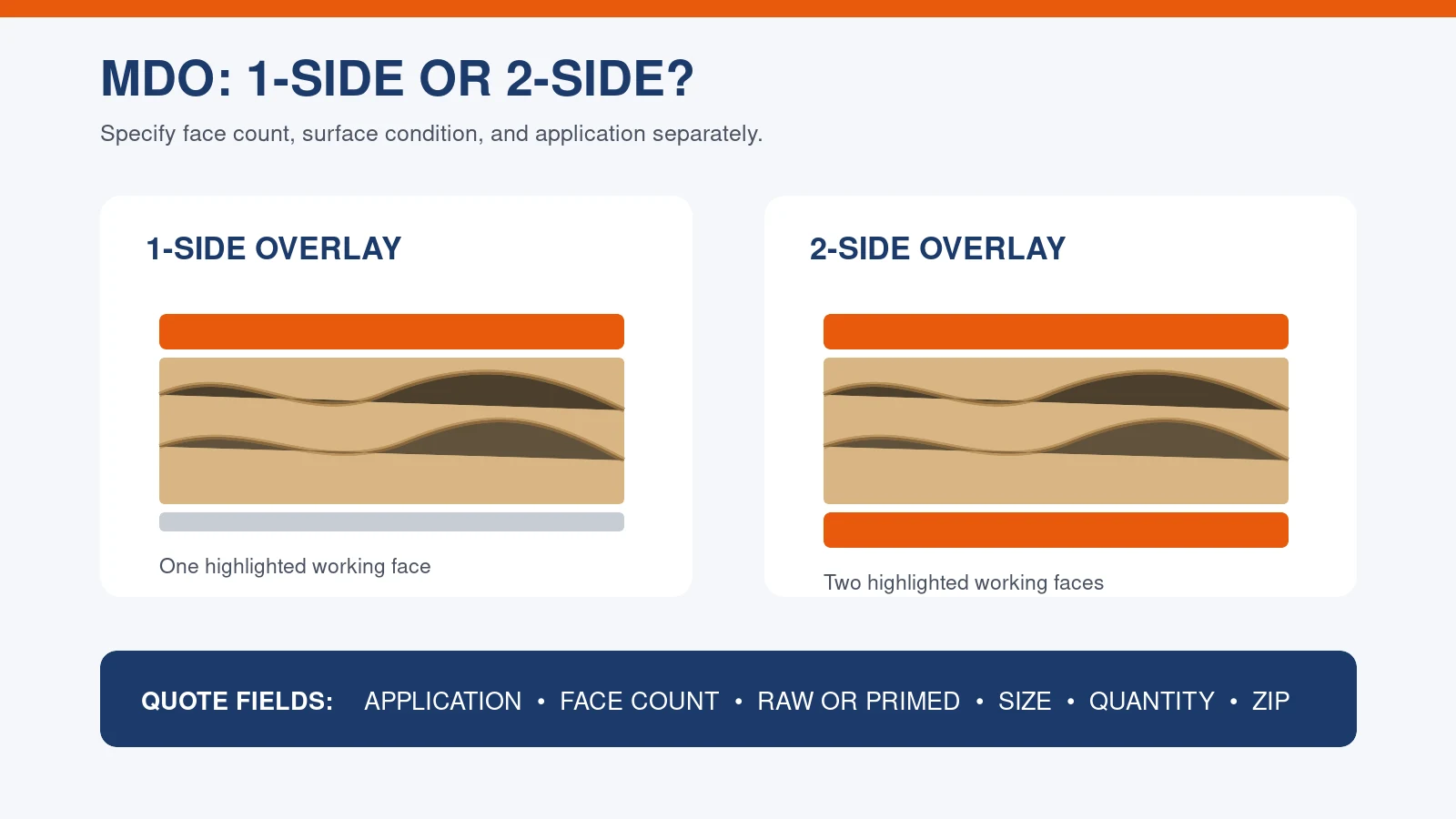
Second, state the working-face count. In the manufacturer examples reviewed for this guide, one-side or G1S means the overlay is on the working face, while two-side or G2S means the overlay is on the face and back. The reverse construction of a one-side panel still needs confirmation for the named product.
Third, state the surface condition. Raw or unprimed MDO, factory-primed MDO, and prefinished MDO are different descriptions. The brown resin overlay is not automatically a primer, and “factory-primed” does not automatically mean “finished.” Ask for the current finishing instructions for the actual panel and coating system.
Fourth, state the physical order fields. Provide thickness, sheet size, quantity, and delivery ZIP. Add a manufacturer, product line, grade, or certification only when the drawing, customer, or governing specification requires it.
Do not confuse 1-side with 1-step MDO
Side count describes where the overlay is located. Step count describes how the panel is manufactured. Roseburg explains that its one-step process presses veneers and overlay together, while its two-step process applies the overlay to a previously pressed and prepared plywood blank. Those manufacturing descriptions belong to the named products and do not guarantee the appearance of every MDO panel. See Roseburg’s 1-step versus 2-step MDO explanation.
A sign buyer may need both answers in the same quote. A useful specification has three separate lines: face count, manufacturing method when documented and relevant, and surface condition. Writing “1S primed” does not tell the supplier whether the buyer also has an appearance requirement tied to the manufacturing method.
Raw, factory-primed, and prefinished are separate choices
Raw or unprimed MDO still needs a finishing system selected for the panel and application. An active Richply General Purpose MDO page provides one named manufacturer example, but its description should not be treated as a universal specification for every brand.
A factory primer is a manufacturer-applied base coat. It may still require compatible topcoats, edge treatment, preparation, and cure time. A dated Swanson Thermo-Set sheet illustrates why “primed” and “finished” should not be treated as synonyms, but its older coating instructions are not current ordering guidance. The controlling source is the current sheet for the panel actually quoted.
Prefinished is a third condition. Before applying paint, vinyl, reflective film, ink, or adhesive, confirm that the named substrate and preparation are accepted by the coating or graphics manufacturer. A small adhesion test can prevent a full production run from becoming the test.
Sign MDO is not another name for form MDO
MDO used for signs and a named MDO product made for concrete forming are not interchangeable order descriptions. A dated Murphy Enhanced Flow MDO Concrete Form sheet is one product-specific example; its construction, release-agent, load, reuse, and handling details must not be generalized to sign panels.
If the actual job is forming, send the buyer to the dedicated concrete form plywood in Miami resource and request the project requirements. This article does not provide form design values, pressure tables, or reuse estimates.
Edge sealing and finishing belong in the sign specification
A factory face and a field-cut edge are not the same condition. List every routed edge, saw cut, drilled hole, and fastener penetration that exposes wood. Then follow the current panel manufacturer and coating-system instructions for those locations. Do not assume that a primed face protects a cut edge.
APA’s active MDO and HDO panel page discusses compatible paint systems for wood panels. The safe purchasing rule is simpler than prescribing a universal paint schedule: identify the exact panel, identify the graphics or coating system, and make sure their preparation and finishing instructions agree. Edge sealing should never be described as making a panel permanently waterproof.
If a project is still choosing between substrates, use the separate comparison of PVC foam board versus MDO for Miami sign shops. Keep that substrate decision separate from the 1S versus 2S decision.
Build the quote line before calling
- Application: sign, concrete form, or another documented use.
- Thickness and sheet size: use the drawing or customer requirement.
- Overlay: one-side or two-side.
- Surface: raw, factory-primed, or prefinished.
- Quantity: number of sheets.
- Delivery ZIP: jobsite or shop ZIP.
- Documents: attach the drawing, finish requirement, or customer specification when applicable.
Use placeholders until the job requirements are known. Do not copy a prior order simply because the sign looks similar. One hidden back, routed edge, coating change, or customer specification can alter the correct quote line.
Frequently asked questions
What does 1-side MDO plywood mean?
It describes a panel with the working overlay on one face in the cited manufacturer examples. It does not describe the manufacturing step count, primer status, or exact back construction. Confirm the named product before ordering.
When should a sign shop consider 2-side MDO?
Start with two-side MDO when both faces will be visible, lettered, painted, or specifically required. That is a starting point, not a claim that 2-side panels are universally stronger or longer-lasting.
Is 1-side MDO the same as 1-step MDO?
No. Side count refers to overlay coverage. Step count refers to a manufacturer’s production sequence. Ask both questions when face appearance or construction method matters.
Is factory-primed MDO ready for final use?
Not automatically. “Primed” identifies a base coat, not necessarily a complete finish. Follow the current panel and coating manufacturers’ instructions for preparation, topcoats, edges, penetrations, and cure.
Do cut MDO edges need treatment?
Follow the current instructions for the exact panel and exposure. Field cuts, routed edges, holes, and penetrations may require treatment even when the face arrives primed. Do not claim that sealing makes the edge moisture-proof.
Can sign-grade MDO be used for concrete forms?
Do not assume so. A named concrete-form product has its own application and handling instructions. State the intended use and verify the current form-panel documentation for the job.
What should I provide for an MDO quote?
Send the application, thickness, sheet size, one-side or two-side requirement, raw or primed requirement, quantity, delivery ZIP, and any drawing or customer specification.
Call with a complete MDO specification
Call International Plywood at (305) 884-0860 or request a wholesale quote. Our team will confirm the named product, current inventory, price, specifications, and delivery timing before the order is released. Hablamos Español. Llámenos al 305.884.0860.